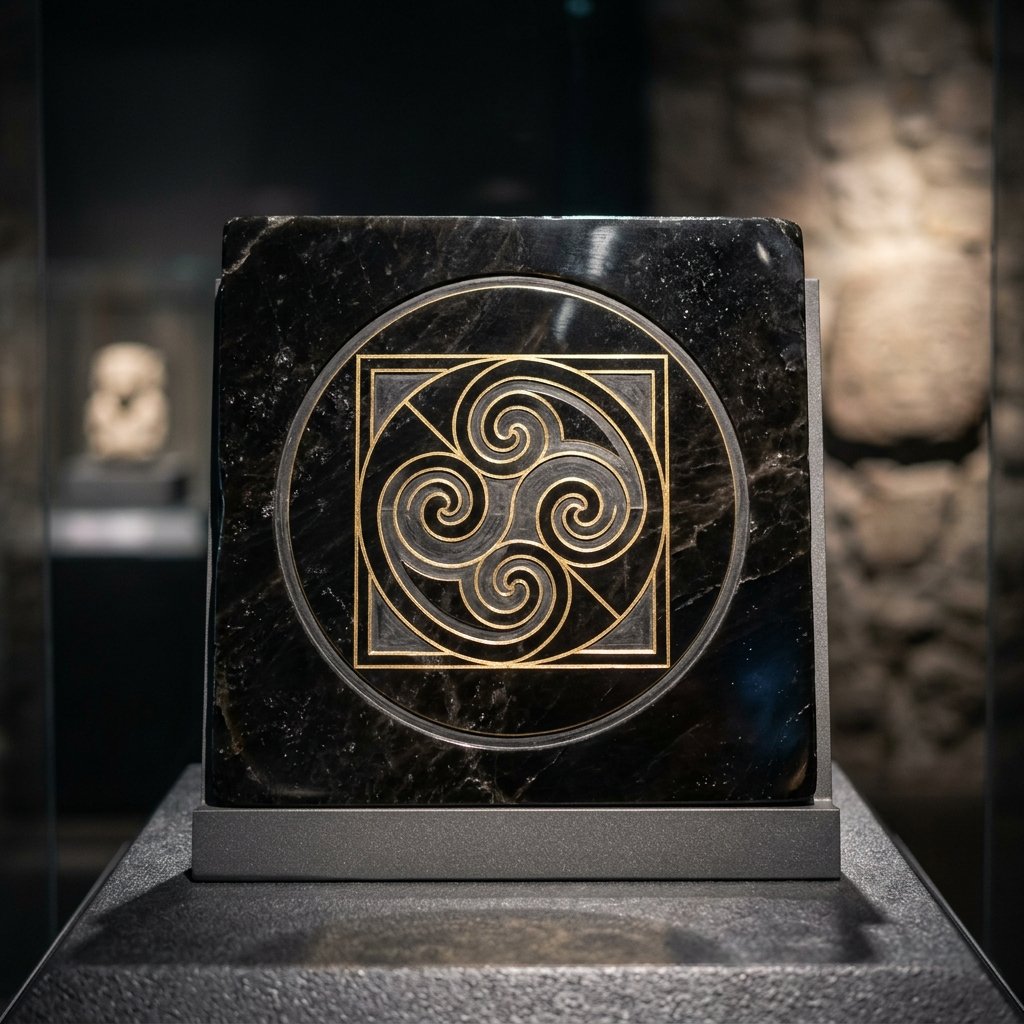
A Critical Distinction
The widely recognized "yin-yang" style Hunab Ku symbol is NOT an ancient Maya hieroglyph or artifact. It does not appear on any pre-Columbian temple, stela, or codex. It is a modern creation popularized by New Age writer José Argüelles in 1987. However, the concept of a single creator deity named Hunab Ku does appear in 16th-century colonial Maya texts—though scholars heavily debate whether it was a genuine indigenous belief or a product of Catholic missionary influence.
The Anatomy of a Modern Myth
If you visit any market in the Yucatan peninsula today, or search online for "Maya tattoos," you will inevitably encounter a striking geometric design: a circle containing a square, inside of which two opposing spirals interlock, resembling a squared-off version of the Asian Yin-Yang symbol. Usually, this design is confidently labeled "Hunab Ku—The Ancient Maya Symbol of the Galactic Center."
It is a beautiful design with deep philosophical appeal. But from an archaeological and historical perspective, it is entirely fictional.
Where Did the Symbol Come From?
The "Hunab Ku symbol" does not exist in the archaeological record. You will not find it carved into the stones of Tikal, painted on the ceramics of Copán, or drawn in the pages of the Dresden Codex.
The specific visual design we recognize today was introduced to the world in 1987 by José Argüelles in his highly influential New Age book The Mayan Factor: Path Beyond Technology. Argüelles was one of the primary architects of the "Harmonic Convergence" and later the 2012 Maya calendar phenomenon. He appropriated a motif found in an Aztec text—specifically, a drawing of a woven mantle (manta) from the colonial-era Codex Magliabechiano—modified the geometry, and rebranded it as the Maya symbol for the center of the Milky Way galaxy.

The Deity vs. The Symbol
The confusion stems from the fact that while the symbol is a modern invention, the name Hunab Ku (meaning "One God" or "Only God") is historical—though highly controversial.
As detailed in our deity profile on Hunab Ku, the name appears in 16th-century Yucatec dictionaries compiled by Spanish friars. The Franciscans, eager to convert the Maya to Christianity, seized upon (or perhaps invented) the concept of Hunab Ku to argue that the Maya "originally" believed in a single, invisible, formless creator god, making the transition to the Catholic God much easier (Restall, M., The Maya World, 1997).
Mainstream Maya scholars note that the concept of an invisible, monotheistic creator who cannot be represented in art contradicts everything we know about Classic Maya theology, which was robustly polytheistic and intensely visual. The creator role in Classic Maya theology was filled by Itzamná, heavily represented in art and inscriptions.
Why the Symbol Endures
Despite its lack of archaeological authenticity, the Argüelles Hunab Ku symbol has taken on a life of its own. It has been embraced by modern Maya spiritual practitioners, artisans, and New Age groups as a symbol of cosmic harmony, the balance of opposites, and galactic consciousness.
In the study of religion, a symbol's power comes from what people believe it means now, not just what it meant in the past. The Hunab Ku design may not be ancient, but it has become a genuine part of contemporary spiritual iconography. As a piece of 20th-century myth-making, it is a fascinating example of how modern cultures reinterpret and romanticize the ancient Maya.
References
- Argüelles, J. The Mayan Factor: Path Beyond Technology. Bear & Company, 1987.
- Boone, E.H. The Codex Magliabechiano and the Lost Prototype of the Magliabechiano Group. University of California Press, 1983. (Source of the original Aztec manta design).
- Restall, M. The Maya World: Yucatec Culture and Society, 1550–1850. Stanford University Press, 1997.
- Taube, K. The Major Gods of Ancient Yucatan. Dumbarton Oaks, 1992.
Frequently Asked Questions
Is the Hunab Ku symbol an authentic ancient Maya glyph?
No. The popular circular symbol with opposing spirals (often called the "Maya yin-yang") does not exist anywhere in ancient Maya art, architecture, or writing. It was created in 1987 by author José Argüelles, who adapted a design from a colonial-era Aztec (not Maya) drawing of a blanket.
What does "Hunab Ku" mean?
In Yucatec Maya, Hun means "one," ab implies a state of being, and k'u means "god" or "sacred." Thus, Hunab Ku translates roughly to "One God" or "Only God."
Did the ancient Maya believe in Hunab Ku?
Most scholars believe genuine pre-Columbian Maya religion was resoundingly polytheistic. The idea of a single, invisible creator god called Hunab Ku was heavily promoted (and potentially invented) by 16th-century Spanish missionaries as a "bridge" concept to help convert the Maya to Catholic monotheism.